Money Lessons Summary
The Richest Man in Babylon Summary: 7 Timeless Money Lessons
The lessons associated with The Richest Man in Babylon have lasted because they are simple enough to remember and stubborn enough to keep mattering. They are told through characters in an ancient city who face ordinary financial situations — earning, spending, borrowing, saving, losing, and starting again — and who arrive at a handful of habits that still describe how most personal finances actually work.
This page is an original summary of seven of those principles, written in plain language, with a short note on how each one tends to be applied today. It is a companion to reading, not a replacement for it, and it is educational rather than personalized advice.
1. Pay yourself first
The first idea in the story is deceptively plain: before a single coin leaves your hands for anyone else, a portion of what you earn should stay with you. Most people treat saving as whatever survives the month. The lesson reverses that order. Your earnings are not fully spoken for the moment they arrive; a share of them belongs to your own future, and that share is set aside first rather than last.
Today: In practice this often looks like an automatic transfer that leaves your checking account on payday, before bills and everyday spending begin. The amount matters less at the start than the habit of doing it consistently. People who begin with a small percentage and raise it as income grows usually find the adjustment easier than those who wait for a comfortable moment that never quite arrives.
2. Control unnecessary expenses
The story observes something uncomfortable: spending expands to match whatever comes in. What people call necessary expenses tend to grow quietly alongside every raise, until a larger income produces exactly the same empty purse. The lesson asks you to separate what you genuinely need from what habit, comparison, or convenience has simply added along the way.
Today: A modern version of this is a plain review of the last two or three months of spending, with each recurring charge examined rather than assumed. Subscriptions, upgrades, and conveniences are not wrong in themselves, but each one should survive a deliberate decision. The purpose is not deprivation; it is making sure the money you spend reflects what you actually value.
3. Put accumulated money to productive work
Money that only sits still does one job. The story treats savings as something that can be put to work so that the amount you set aside is no longer the only thing building your position. This is where the narrative introduces patience: results accumulate gradually, through repetition, rather than through a single clever decision.
Today: Today this idea maps onto the general practice of putting long-term savings somewhere it can grow rather than leaving every dollar idle. What is appropriate depends entirely on your circumstances, timeline, and tolerance for risk, and outcomes are never guaranteed. The durable part of the lesson is the mindset: treat accumulated savings as working capital for your future rather than as a balance you happen to have.
4. Protect savings from avoidable loss
The story is direct about how savings disappear. They are rarely lost through a dramatic disaster; more often they leave through an arrangement that sounded promising and was never examined closely. The counsel is to guard the principal first, to be skeptical of returns that seem out of proportion to the risk, and to seek advice from people whose experience is relevant rather than merely confident.
Today: A contemporary reading: understand anything before you commit money to it, verify who you are dealing with, and be especially cautious about urgency, secrecy, or pressure. Losses that are avoided are just as valuable as gains that are earned, and they are considerably easier to control.
5. Make housing decisions wisely
Where you live is usually the single largest claim on your income, and the story treats it as a decision worth making deliberately rather than by default. Handled thoughtfully, a home is a source of stability. Handled carelessly, it quietly consumes the margin that every other principle depends on.
Today: The practical question is not whether to rent or to buy in the abstract — it is whether a particular housing cost leaves enough room for saving, for unexpected expenses, and for the life you want outside of the four walls. Costs beyond the monthly payment, including maintenance, insurance, and taxes, belong in that calculation. Housing decisions involve significant personal and financial tradeoffs, and many people benefit from talking them through with a qualified professional.
6. Prepare for future income needs
The story looks past the present year to a time when earning may slow or stop, and to the people who depend on you. Preparation is framed as an act of care taken in advance, while there is still time for small, regular contributions to accumulate into something meaningful.
Today: This is the thinking behind steady long-term saving, an emergency reserve for interruptions in income, and making sure important documents and beneficiary details are current. None of it requires a large sum at the outset. It requires beginning early enough that consistency can do most of the work.
7. Increase your ability to earn
The final principle turns back toward the person. Skill, judgment, reputation, and a willingness to keep learning are what raise the ceiling on everything else. In the story, the people who improve their circumstances are the ones who take their craft seriously and become worth more to those they serve.
Today: Modern equivalents are familiar: developing a skill that is genuinely in demand, doing work that people are glad to recommend, and continuing to learn after formal education ends. Improving your earning ability also strengthens every other principle, because saving a share of a larger income is easier than saving a share of a smaller one.
How the Seven Principles Work Together
Read individually, each principle sounds like common sense. Read together, they form a sequence. Keeping a share of what you earn creates something to manage. Controlling expenses protects that share. Putting savings to work and guarding them against avoidable loss determines whether the share grows or quietly erodes. Housing decisions and preparation for future income set the boundaries the whole plan lives inside. And improving your ability to earn raises what every other step can accomplish.
No single principle carries the weight on its own, and none of them promises a particular result. What they describe is a direction of travel, maintained long enough for ordinary decisions to compound into a different financial position.
Why Present These Lessons as a Graphic Novel?
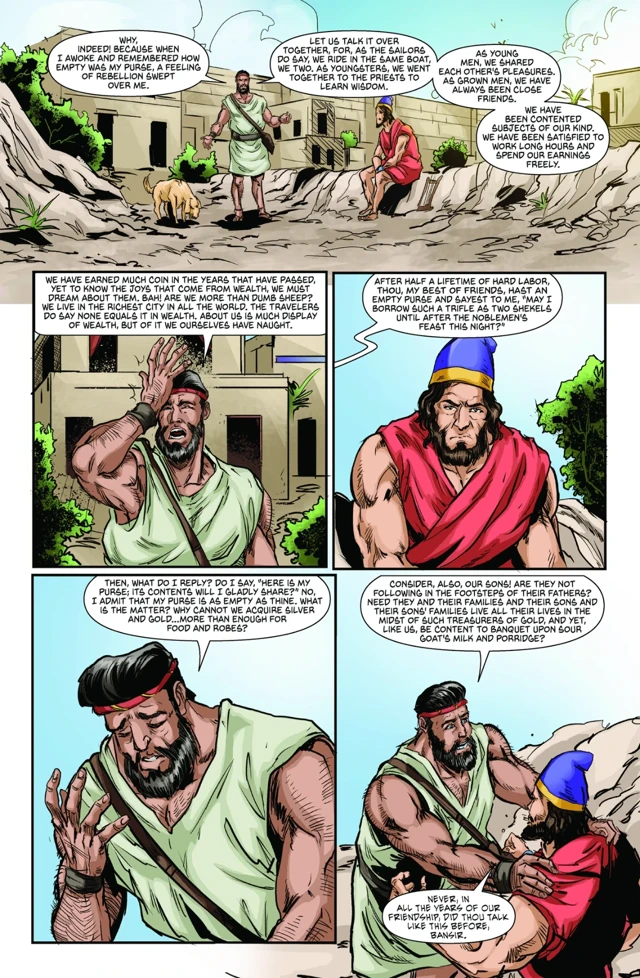
Financial ideas are abstract until someone lives them. Illustrated storytelling puts the characters, the choices, and the consequences on the page where a reader can see them: the moment a decision is made, the expression that follows, the situation that results a year later. A principle that reads as advice in a paragraph becomes a scene you can picture and recall.
That visual approach also lowers the entry barrier. A teenager, a reluctant reader, or an adult returning to money basics can follow a story more easily than a chapter of instruction, and a family can read the same pages and talk about them together. The goal is not to simplify the ideas but to make them easier to experience and remember.
If you would like to see how that looks, you can start with the free eight-page sample, or read more about this adaptation on the Richest Man in Babylon graphic-novel home page.
This summary is educational and general in nature. It is not personalized financial, investment, tax, legal, or credit advice, and no particular financial outcome is promised or implied. This graphic-novel adaptation is a companion to the ideas discussed here, not a substitute for reading the book itself or for guidance from a qualified professional.
This is an independently created graphic-novel adaptation inspired by the enduring money lessons associated with The Richest Man in Babylon. It is not an official or authorized edition and is not affiliated with or endorsed by any modern publisher or rights holder.